
AI Pre-Match vs Live Signals Explained — How Two Systems Create One Edge
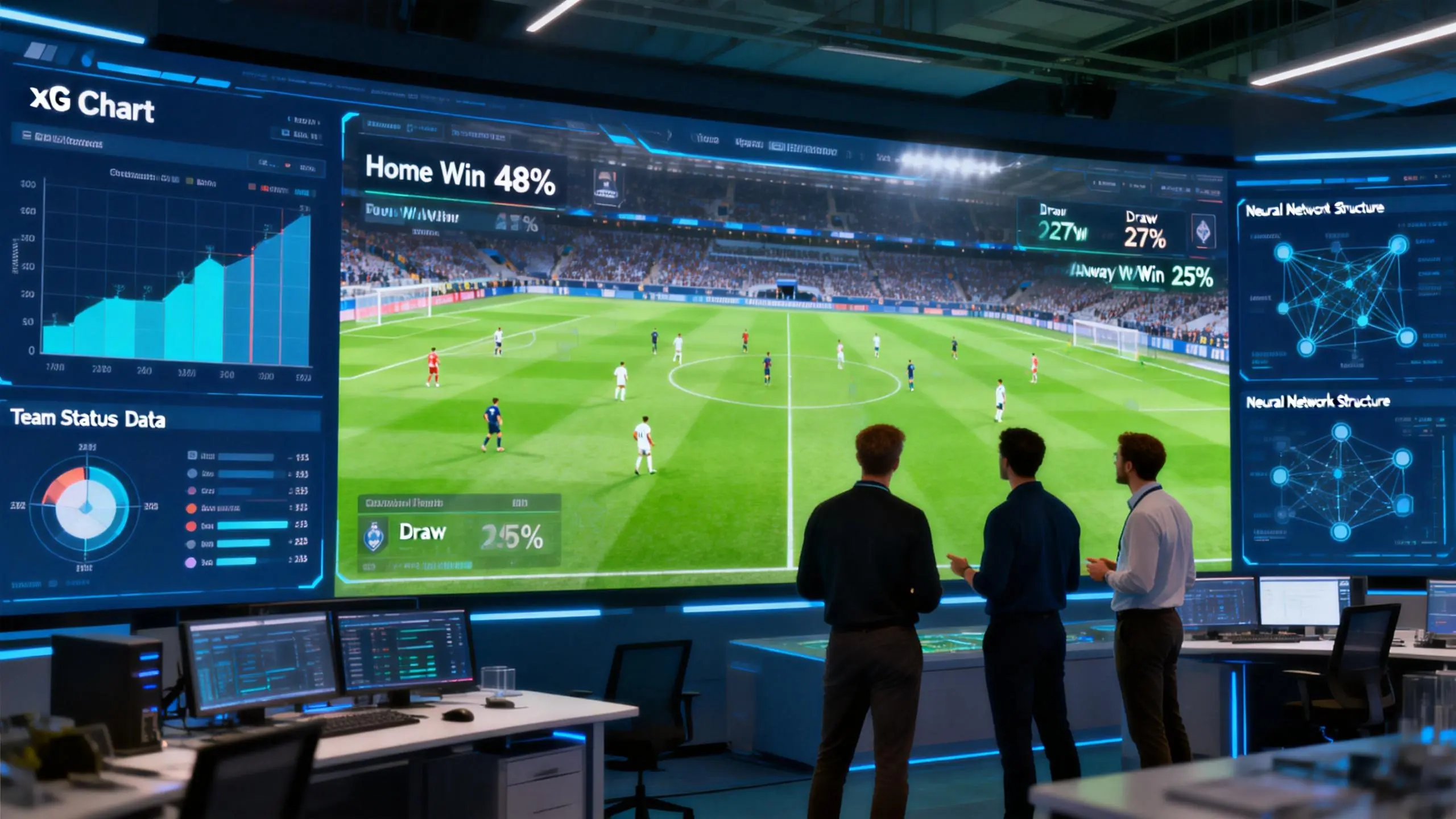
Most AI prediction platforms do one thing: they tell you what might happen before the match starts. OddsFlow does two things. Pre-match analysis sets the baseline. Live signals detect when reality diverges from that baseline. Together, they create an edge that neither system can achieve alone.
This is the technical deep dive into how both systems work, when each one fires, and why the combination produced +$69,381 at the World Cup 2026.
How Pre-Match AI Works
The Dixon-Coles Model
OddsFlow's pre-match engine is built on the Dixon-Coles model — a statistical framework that estimates attack and defense strength parameters for every team.
The model works by analyzing historical match data to estimate two key parameters per team:
| Parameter | What It Measures | Example |
|---|
| Attack strength (alpha) | How many goals a team is expected to score | France: 1.42 (high) |
| Defense strength (beta) | How many goals a team is expected to concede | France: 0.78 (low = strong defense) |
10,000 Monte Carlo Simulations
For each match, the model runs 10,000 Monte Carlo simulations. Each simulation plays out the match with randomized outcomes weighted by the probability distributions. The results:
| Output | Description |
|---|
| 1X2 probabilities | Win/Draw/Loss percentages |
| Asian Handicap fair line | The handicap line where both sides have equal expected value |
| Over/Under probability | Percentage chance of total goals exceeding each line |
| Score matrix | Probability of every possible scoreline (0-0 through 5-5+) |
| Market | AI Estimate | Bookmaker Line |
|---|
| Norway win | 52.3% | 48.1% (odds 2.08) |
| AH Norway -0.5 | 52.3% | Odds 1.91 |
| Over 2.5 | 58.7% | Odds 1.85 |
How Live Signals Work
Real-Time Odds Scanning
The moment a match kicks off, the live system activates. It connects to odds feeds from 10+ bookmakers and records every price change every 10-20 seconds.
This is not manual analysis. The system processes thousands of odds updates per minute across all active World Cup matches simultaneously.
Detection Algorithms
The live system watches for five types of anomalies:
| Signal Type | Detection Method | Threshold |
|---|
| Sharp money movement | Large stake detected at specific bookmakers known for accepting sharp bettors | >$500K in 60 seconds |
|---|---|---|
| Consensus shift | Majority of bookmakers move in the same direction simultaneously | 7/10 books move same way |
| Rapid odds drop | Single bookmaker drops odds significantly in a short window | >15% drop in 2 minutes |
| xG divergence | Expected goals (from live match data) diverges significantly from actual score | xG > goals + 1.0 |
| Momentum indicator | One team generates multiple consecutive chances without scoring | 3+ shots in 5 minutes, no goal |
What Triggers a Live Signal — Real Examples
Norway vs Senegal, 48th minute (Haaland goal):
Before the goal, Norway's in-play AH line was -0.25. The moment Haaland scored, odds across all 10 bookmakers shifted within seconds. The system detected:
- Consensus shift: 10/10 bookmakers moved Norway AH line
- Rapid odds drop: Norway -0.5 AH dropped from 2.10 to 1.65
- Signal generated: Norway AH and Over 2.5
Belgium 0-0 Iran, 62nd minute:
No goals, but xG was 0.4 for Belgium, 0.2 for Iran. Total xG of 0.6 at the 62nd minute in a match with an Over/Under line of 2.25 triggered the Under signal. The system detected:
- xG divergence: match trending far below expected goal output
- Consensus shift: 8/10 bookmakers moved Under line
- Signal generated: Under 2.25
The Handoff: When Pre-Match Ends and Live Begins
Here is the timeline of a typical World Cup match showing when each system operates:
| Time | System Active | What Happens |
|---|
| -24 hours | Pre-match | Dixon-Coles model generates probability estimates |
| -6 hours | Pre-match | Model updates with final team news and market movement |
| -1 hour | Pre-match | Final pre-match signals generated based on closing odds |
| Kickoff | Both | Live system activates, pre-match baseline locked in |
| 0-15 min | Live | Early-match calibration, signals based on odds movement vs baseline |
| 15-45 min | Live | Primary signal generation window, most pre-match signals confirmed or invalidated |
| Half-time | Live | Line reset, new baseline established for second half |
| 45-75 min | Live | Highest signal volume period, tactical changes visible |
| 75-90+ min | Live | Late-game signals, highest urgency, shortest time to settlement |
A 15% odds drop in isolation means nothing. But a 15% odds drop when the pre-match model expected Team A to be favored — that is a confirmed signal. The pre-match baseline gives live signals context.
Combined Strategy: The OddsFlow Edge
The Divergence Principle
The bigger the gap between pre-match expectation and live reality, the stronger the signal. This is the core principle:
Pre-match model says X should happen. Live data shows Y is happening. The bigger the gap between X and Y, the more likely the market has not fully adjusted.
Example: Germany vs Ivory Coast
- Pre-match: Germany -1.5 AH (strong favorite)
- 30th minute: Kessie scores for Ivory Coast (0-1)
- Live odds: Germany AH line collapses
- 60th minute: Germany's xG reaches 2.1, score still 0-1
- Divergence signal: xG (2.1) vs actual goals (0) = massive divergence
- 68th minute: Undav equalizes
- 90+4': Undav scores winner
The live system detected that Germany was creating far more chances than the scoreline suggested. The xG divergence signal fired before the equalizer. Pre-match had Germany as favorites; live confirmed they were playing like favorites despite trailing.
Market Specialization
Our World Cup 2026 data reveals which markets work best for each system:
| Market | Pre-Match Strength | Live Signal Strength |
|---|
| 1X2 (Match Result) | Strong — win probabilities well-calibrated | Moderate — useful after goals |
| Asian Handicap | Very strong — best pre-match market | Strong — line adjustments after events |
| Over/Under | Moderate — depends on league averages | Very strong — best live market |
Results: What the Data Says
Before vs After Model Calibration
| Metric | Jun 11-17 (Pre-Calibration) | Jun 18-23 (Post-Calibration) |
|---|
| Win Rate | 36% | 64% |
|---|---|---|
| P/L | -$89,814 | +$159,195 |
| Signal quality | Low — model overfit to historical data | High — tournament-specific adjustments |
Top Combined Wins
| Match | 1X2 | AH | O/U | Total P/L |
|---|
| Norway 3-2 Senegal | +$25,887 | +$14,514 | +$26,515 | +$66,916 |
|---|---|---|---|---|
| Uruguay 2-2 Cape Verde | +$19,225 | +$7,171 | +$1,502 | +$27,900 |
| Japan 4-0 Tunisia | — | +$25,932 | — | +$25,932 |
| Scotland 0-1 Morocco | — | +$11,154 | +$11,710 | +$22,864 |
Biggest Losses (Transparency)
| Match | P/L | Lesson |
|---|
| Sweden 5-1 Tunisia | -$27,000 | Model severely underestimated Sweden's form |
| England 4-2 Croatia | -$27,473 | High-scoring match defeated both AH and O/U positions |
| Argentina 3-0 Algeria | -$17,866 | Messi performance exceeded all model parameters |
| Spain 4-0 Saudi Arabia | -$10,000 | One-sided matches with no live recovery path |
How to Use Both Systems Together
Step 1: Pre-Match Setup (Hours Before Kickoff)
Visit /worldcup/predictions to see the Dixon-Coles model output for upcoming matches. Note the AI's recommended signals for 1X2, AH, and O/U.
Step 2: Live Monitoring (During the Match)
Open the Live Signal Room or World Cup Live Room. Watch for live signals that confirm or contradict the pre-match analysis.
Step 3: Telegram Alerts
Join OddsFlow Telegram for push notifications the moment a signal fires. No need to watch the dashboard.
Step 4: Context with Ask AI
Use Ask AI to get instant, data-driven context on any match or signal.
What Comes Next: Knockout Rounds
The Round of 32 introduces new dynamics:
- Single elimination = every signal carries more weight
- Extra time = O/U recalibration at 90 minutes
- Penalty shootout = new market (1X2 becomes less relevant after 90')
- Higher tactical caution = fewer early goals, more late-game signals
The pre-match + live combination becomes even more critical when a single goal can end a team's World Cup.
Join OddsFlow Telegram — Free live signals for every World Cup 2026 match.
Ask AI — Instant AI analysis for any World Cup match.
Sign Up Free — Pre-match predictions + live signals for World Cup 2026 and 19+ leagues. No credit card required.
⏰ World Cup 2026 ends July 19. Get free AI signals for every remaining match — join before the tournament ends.

*All results verified at /worldcup/performance and /worldcup/performance. Performance metrics based on 713 bets across 44 World Cup matches. Predictions for informational and entertainment purposes only. Always bet responsibly.*