🌤️ Klimadaten
📍 Standort
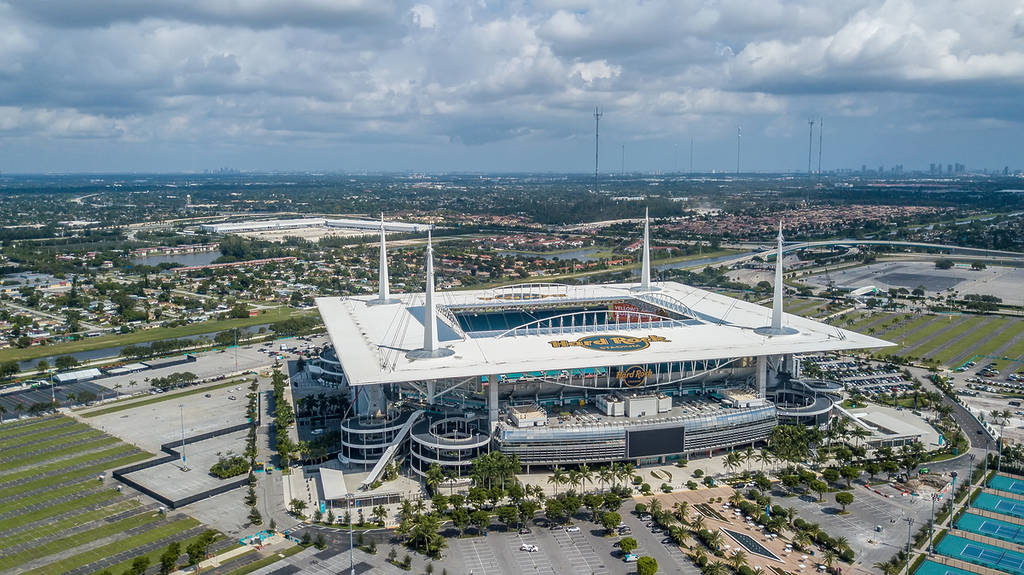
MOST DANGEROUS VENUE. Tropical heat + extreme humidity. Canopy covers seats but field fully exposed.
⚠️ Hauptbedenken
CRITICAL HEAT: Near-certain to exceed WBGT 26°C every match. Tropical humidity prevents sweat evaporation. Cold-climate teams severely disadvantaged.
⚽ Spiele an diesem Ort (4)


KI-Stadionbericht
Umweltanalyse-Modell
Hard Rock Stadium
Miami, USA | Kapazität: 65.000 | Open-Air mit teilweiser Überdachung
Ort & Klima
- ◆Koordinaten: 25.958°N, 80.2389°W
- ◆Höhe: 2m über dem Meeresspiegel
- ◆Zeitzone: EDT (UTC-4)
- ◆Juni-Temperatur: 32°C hoch / 24°C tief
- ◆Juli-Temperatur: 33°C hoch / 25°C tief
- ◆Luftfeuchtigkeit: ~70%
- ◆WBGT-Bereich: 27-29°C
- ◆Klima: GEFÄHRLICHSTER AUSTragungsort. Tropische Hitze + extreme Luftfeuchtigkeit. Überdachung deckt Sitze ab, aber Spielfeld voll exponiert.
Leistungseinfluss
HITZE (KRITISCH): Dies ist der klimatisch gefährlichste Austragungsort des Turniers. Ein WBGT von 27-29°C überschreitet mit nahezu Sicherheit den FIFPRO-Schwellenwert von 28°C für Kühlpausen. Spieler aus kalten und gemäßigten Klimazonen werden Folgendes erleben:
- ◆Deutliche Reduzierung der insgesamt zurückgelegten Distanz (bis zu 5-8%)
- ◆Beeinträchtigte kognitive Funktion und Entscheidungsgeschwindigkeit
- ◆Erhöhtes Risiko einer Körperkerntemperatur (>38.5°C löst Leistungsabfall aus)
- ◆Reduzierte Sprintkapazität mit hoher Intensität in der zweiten Halbzeit
Angepasste Teams: CONCACAF-Nationen, afrikanische Teams, Teams aus dem Nahen Osten, südamerikanische tropische Nationen Am stärksten gefährdete Teams: Nordeuropäische Nationen (Norwegen, Schweden, Schottland, England, Niederlande), ostasiatische Teams (Japan, Südkorea)
Stadioneigenschaften
- ◆Typ: Open-Air mit teilweiser Überdachung
- ◆Klimaanlage: Nein
- ◆Dach: Nein
- ◆Hauptanliegen: KRITISCHE HITZE: Nahezu sicher wird der WBGT-Wert bei jedem Spiel 26°C überschreiten. Tropische Luftfeuchtigkeit verhindert Schweißverdunstung. Teams aus kalten Klimazonen stark benachteiligt.
Spiele an diesem Austragungsort
- ◆Saudi-Arabien vs Uruguay (2026-06-15)
- ◆Uruguay vs Kap Verde (2026-06-21)
- ◆Schottland vs Brasilien (2026-06-24)
- ◆Kolumbien vs Portugal (2026-06-27)
Quelle: Esh et al. 2026, "Evidence-Based Guidelines to Protect Player Health and Performance from Environmental Challenges", Sports Medicine (DOI: 10.1007/s40279-026-02398-4)