
Why Your Accumulator Keeps Dying on the Last Leg
You know the feeling. Three legs green, one to go. Then an 88th-minute goal erases the lot.
That is not bad luck. That is arithmetic — and it can be calculated exactly.
This article does not sell "guaranteed accumulators" or "100% accurate predictions". Nobody can give you those, and anyone promising them is selling something else. What we have is a public track record: every signal we publish, the price it opened at, how it settled, and what it won or lost — all open to inspection.
That record is what this article is built from.
The Arithmetic Prediction Sites Rarely Show You
Let us use our own real numbers rather than textbook ones.
On league football (excluding the World Cup), our model records:
| Settled bets | 10,640 |
|---|---|
| Matches covered | 1,043 |
| Win rate per leg | 55.77% |
| ROI | +16.93% |
Now watch what happens when those legs are combined. The chance that all legs win is 0.5577 raised to the number of legs:
| Accumulator | Chance every leg wins |
|---|
| 2 legs | 31.1% |
|---|---|
| 3 legs | 17.3% |
| 4 legs | 9.7% |
| 5 legs | 5.4% |
| 6 legs | 3.0% |
This is not a flaw in the model. It is what multiplication does. Even excellent selection collapses once you multiply it.
First conclusion: if someone offers five- and six-leg "banker accumulators" every day, ask one question — where is the public record? Not winning screenshots. The complete record, losses included.
So Why Does Anyone Play Accumulators?
Because the arithmetic cuts both ways.
The chance of winning falls steeply, but the payout climbs steeply too. Four legs at 1.90 each returns 1.90⁴ = 13.03× your stake.
The question is not "are accumulators bad". The question is: is the price on offer worth the true probability?
That is where data earns its keep. You cannot answer it on instinct. You need two things:
- 1An honest probability estimate for each leg
- 2The market price currently offered on that leg
The gap between them is the only rational reason to place a bet at all — accumulator or single.
How We Judge a Single Leg
Our model does not "guess who wins". It estimates a goal distribution for both teams, then derives the probability of every market from that distribution.
Three things we check before a leg is worth considering:
1. Is the price better than the true probability?
If the model puts a selection at 60%, break-even is 1.67. If the market offers 1.90, that is a real gap. If it offers 1.60, skip it — however confident you feel.
2. Does the handicap line make sense?
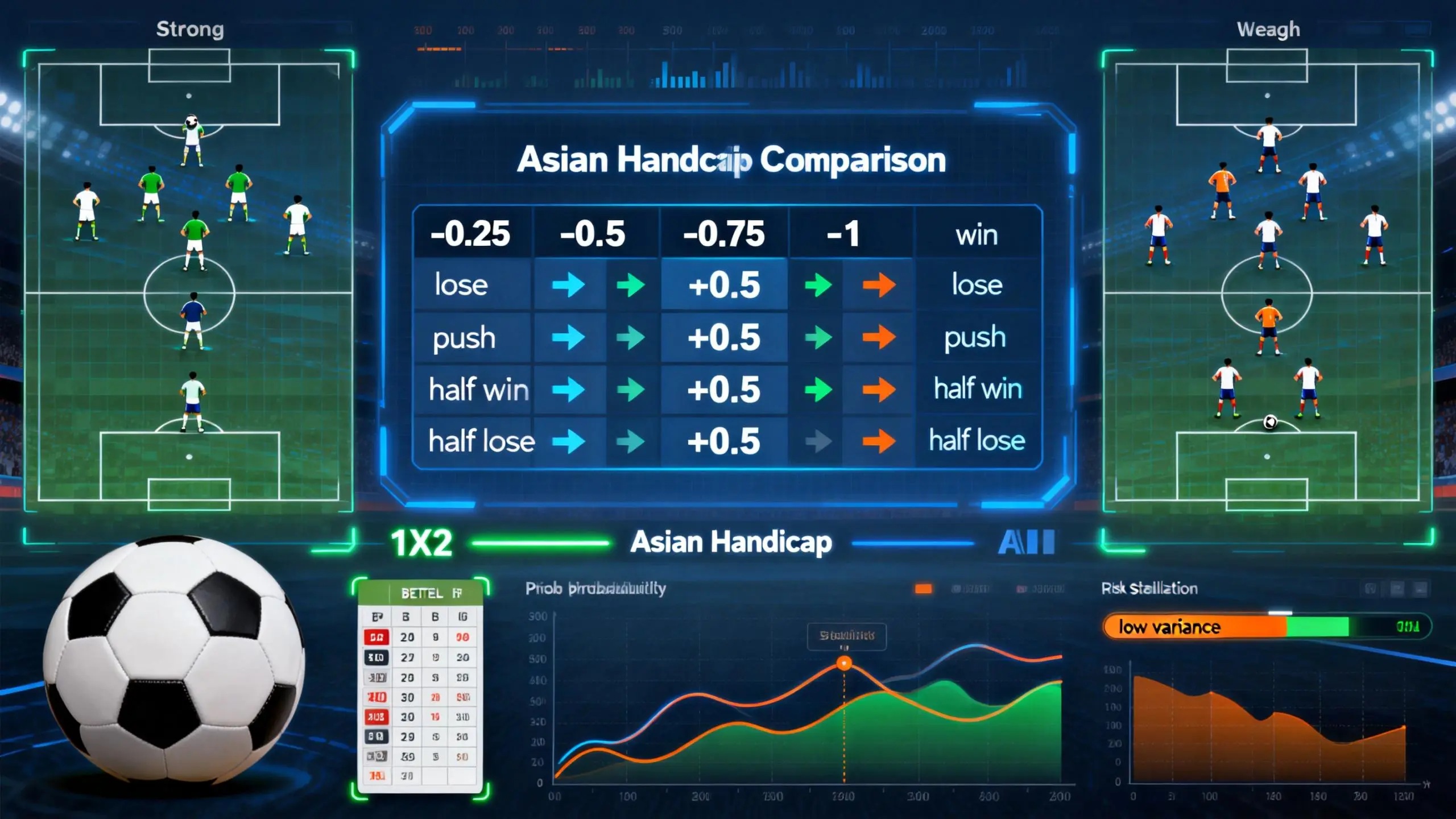
Quarter-ball Asian Handicaps (0.25 / 0.75) split the stake in two. That changes the risk profile materially, and it is often where the best prices sit.
3. Is the market moving against you?
Opening and closing prices tell different stories. A leg whose price has drifted against you since it opened usually drifted for a reason.
You can see all of this on our predictions page — line, price, and reasoning, for today's fixtures.
Not All Markets Are Equal — Our Own Data Says So
If you are building an accumulator, the market you pick for each leg matters as much as the team.
Here is the breakdown across 12,113 settled bets, split by market:
| Market | Bets | Win rate | ROI |
|---|
| Asian Handicap | 5,326 | 55.7% | +14.9% |
|---|---|---|---|
| Over / Under | 3,792 | 57.6% | +13.0% |
| 1X2 (Win-Draw-Win) | 2,995 | 41.6% | −0.5% |
We publish it because that is what the data says. A site that shows only its good numbers is choosing what you get to see.
Why is 1X2 harder? Because it is the most crowded market in football. Everyone has an opinion on who wins. Prices there are already efficient — the gaps are gone.
Asian Handicap and Over/Under behave differently. Their lines move in fractions (−0.25, −0.75, 2.75), and it is in those fractions that prices most often drift from true probability.
For accumulators the implication is direct: legs built in markets where you have a measurable edge beat "big team must win" legs in the 1X2 market — even though the second feels safer.
Correlated Legs Are the Hidden Trap
The 0.5577-to-the-power-of-N calculation above assumes every leg is independent.
In practice they often are not.
Two patterns that show up constantly on accumulator slips:
- "Team A wins" + "Under 2.5 goals" — sounds conservative. But a team pushing hard for the win tends to leave space behind it. These two legs pull against each other.
- "Team A −1.5" + "Over 2.5 goals" — these reinforce each other. If A wins by two, the total has almost certainly cleared 2.5.
The first makes the combined probability worse than simple multiplication suggests. The second makes it better.
Most accumulator calculators — including the ones on bookmaker sites — ignore this entirely. They multiply the odds and stop there.
If two of your legs come from the same fixture, ask one question before staking: if the first leg wins, does that make the second more likely or less likely? The answer decides whether your slip is better or worse than the odds claim.
If You Are Going to Play Accumulators Anyway
We are not going to tell you to stop. But a few things make the arithmetic less brutal:
Use fewer legs. The difference between three legs (17.3%) and five (5.4%) is enormous. Each extra leg roughly halves your chance.
Never add a leg just to lift the odds. Any leg added without a price edge makes your expectation worse, not better.
Avoid negatively correlated legs. "Team A wins" plus "under 2.5" looks safe and quietly works against itself.
Measure, do not remember. Memory keeps the wins and discards the losses. Log every slip. After fifty, the numbers will tell you something your feelings will not.
How to Check Us
Every prediction site claims accuracy. So do not trust the claim — check the data.
- Performance page — every settled bet, by competition, with opening price, settlement result, ROI and win rate recomputed daily
- Open data — we publish our settlement data publicly so anyone can audit it
The 55.77% and +16.93% above come from that same source. If the numbers fall next month, those pages will show them falling. That is what a track record is for.
In Short
Accumulators are not a scam, but they are not a shortcut either. They are a high-variance bet whose arithmetic works against you unless every leg carries a genuine price edge.
The part we can help with is that one: an honest probability for each fixture, the current market price, and an open record so you can judge for yourself whether our estimates deserve your trust.
The rest — how many legs, how much, when to stop — stays your call.
See today's predictions · Live signal room · Full track record