
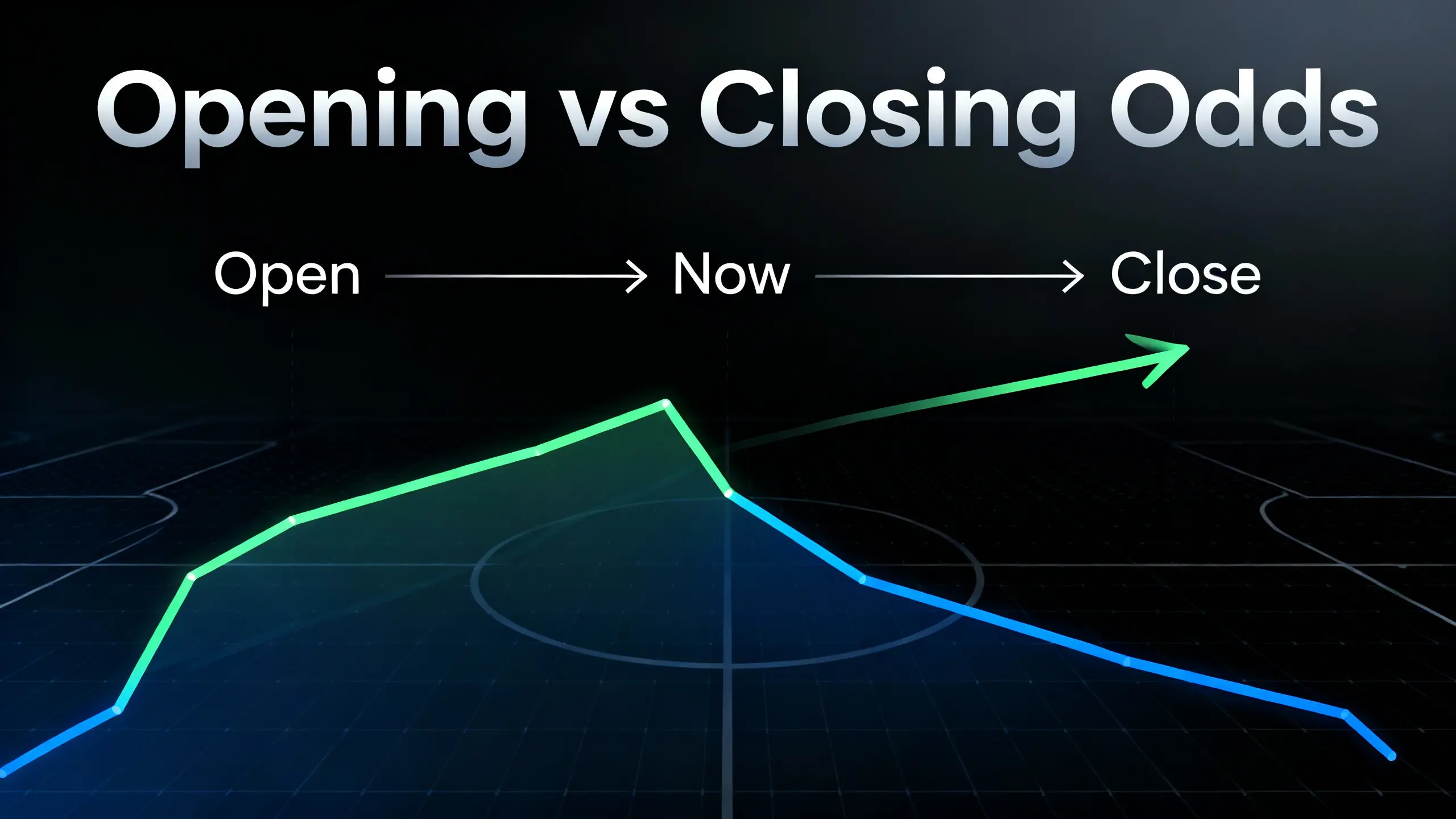
Why Timing Matters in Market Data
One of the first lessons I learned when building prediction models: the *when* of data collection matters as much as the *what*.
Opening odds and closing odds for the same match can look quite different. Understanding why—and how to handle this in analysis—is fundamental to working with market data properly.
The Three Timestamps
| Snapshot | What It Represents |
|---|
| Opening | First widely available price |
| Current | Latest price at any moment |
| Closing | Final pre-kickoff price |
What This Means for Analysis
The key insight: later prices contain more incorporated information, but that doesn't make them "better" for all purposes.
When comparing matches:
- Compare opening-to-opening or closing-to-closing
- Mixing timestamps creates unreliable comparisons
For model building:
- Be explicit about which timestamp your features use
- Time-series features (open → close delta) are often more useful than single snapshots
Common Timing Features in Our Models
At OddsFlow, we extract several timing-based features:
- Opening probability — earliest market belief
- Closing probability — final pre-match belief
- Movement delta — change from open to close
- Movement velocity — how fast changes accumulate
- Stability score — smooth vs volatile path
The movement pattern often contains signal that static snapshots miss.
The Backtest Warning
This is important for anyone evaluating prediction systems (including ours):
If your model makes predictions using data available at time T, you must evaluate against benchmarks using data from time T—not later.
Using closing odds to evaluate predictions made with opening data will make your system look artificially good. We're careful about this in our own evaluation, and you should be too.
Practical Takeaways
- 1Always know which timestamp your data represents
- 2Compare apples to apples — same timestamp comparisons
- 3Movement patterns contain signal — not just final values
- 4Backtest honestly — match evaluation timing to prediction timing
📖 Related reading: Odds Movement Patterns • How We Build Features
*OddsFlow provides AI-powered sports analysis for educational and informational purposes.*