
The Low Block Revolution — How Underdogs Are Dismantling World Cup Favourites on the Counter
We are witnessing a tactical sea change at the 2026 World Cup. The supposed "smaller" sides are not just hanging on anymore. They are sitting deep, organising a rock-solid low block, and waiting for exactly the right moment to strike. And they are punishing the big boys on the counter with ruthless efficiency.
The Evidence: Three Matches That Tell the Story
Ghana 0-0 England (Group L, Matchday 2)
England dominated possession — estimates put it near 80%. And yet, Southgate's men could not break through. Ghana's defensive shape was immaculate: two banks of four, narrow spacing, every passing lane crowded out before it opened.
The scariest part for England? Ghana were not just absorbing pressure — they were threatening on the break. Lightning transitions, three or four players sprinting forward the moment possession changed, stretching England's high defensive line repeatedly.
Result: 0-0. England had the ball. Ghana had the plan.
Cape Verde vs Argentina (Round of 32, July 3 — Hard Rock Stadium, Miami)
The smallest nation ever to reach the knockout stage pushed the tournament favourites all the way to extra time. Cape Verde sat deep, soaked up everything Messi and company threw at them, and cut through on the counter with blistering speed.
This was not luck. This was organisation. Cape Verde closed every half-space, forced Argentina wide into low-percentage crosses, and broke with two or three touch transitions that bypassed Argentina's midfield entirely. It took everything the defending champions had to edge past them.
DR Congo vs England (Round of 32, July 1 — Mercedes-Benz Stadium, Atlanta)
Congo DR led 1-0 at half-time. This was not a smash-and-grab — they had 47% possession and created clear chances. Wissa's movement between the lines troubled Rice and Stones repeatedly. England needed a second-half comeback and a moment of individual brilliance to win 2-1.
The pattern is unmistakable: elite teams dominate the ball, probe for openings, and find nothing. One mistake, and suddenly they are outnumbered at the back.
The Data: Why Traditional Attacks Are Failing
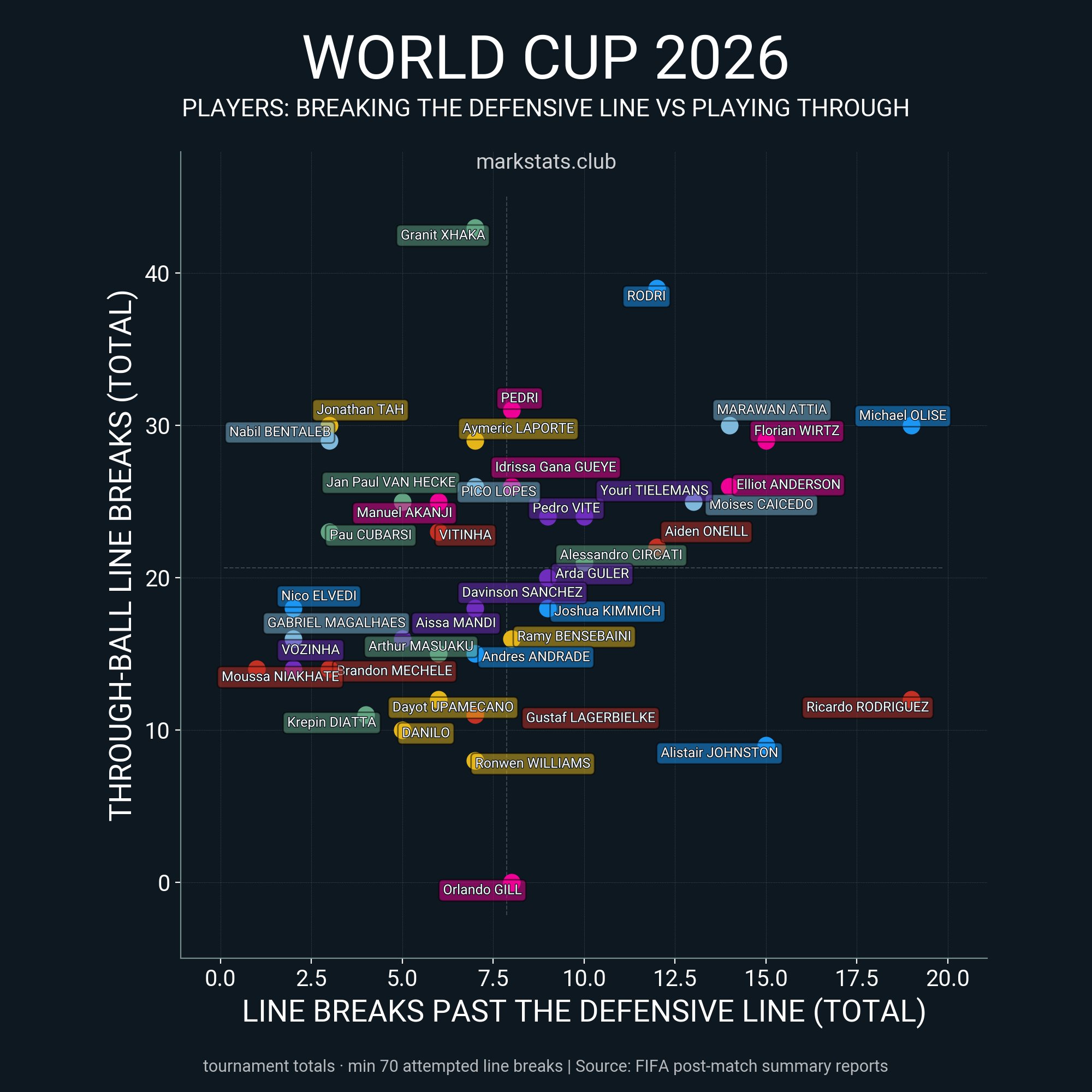
FIFA's post-match summary reports reveal a striking insight through their line-break statistics — the metric that measures how often players successfully break past the opposition's defensive line or thread through-balls behind it.
Players with the most line breaks past the defensive line (tournament totals):
| Player | Team | Line Breaks |
|---|
| Michael Olise | France | ~20 |
| Ricardo Rodriguez | — | ~20 |
| Marawan Attia | Egypt | ~15 |
| Florian Wirtz | Germany | ~15 |
| Player | Team | Through-Ball Line Breaks |
|---|
| Granit Xhaka | Switzerland | ~45 |
| Rodri | Spain | ~38 |
| Pedri | Spain | ~32 |
| Jonathan Tah | Germany | ~30 |
The players breaking lines the most are the ones whose teams are struggling the most against low blocks. The high volume reflects desperation, not dominance. These teams throw everything forward, probe constantly, and still cannot convert territorial control into goals.
Meanwhile, the low-block specialists — Ghana, Cape Verde, Congo DR, Morocco — do not need high line-break numbers. They need one. One successful counter. One transition. And they make it count.
Why the Low Block Works So Well in 2026
1. The 48-Team Format Changes Everything
With 48 teams and expanded group stages, more "smaller" nations are in the tournament — but critically, they arrive better prepared. Modern coaching analysis, video scouting, and tactical software are no longer luxuries reserved for European federations. A team like Cape Verde can study Argentina's pressing triggers, passing patterns, and defensive transitions in granular detail.
2. The Physical Gap Has Closed
Fitness, nutrition, and sports science have globalised. African and smaller South American teams can now match European sides for 90 minutes (and beyond) in terms of physical output. The old model of "tire them out and score late" simply does not work when the underdogs can sustain their defensive shape into extra time.
3. Counter-Attacking Is a Skill, Not a Last Resort
The low block of 2026 is not bus-parking. These teams are executing rehearsed, structured counter-attacks — pre-planned movements triggered by specific turnovers. When Ghana win the ball, they do not boot it forward and hope. They have designated runners, designated ball-carriers, and designated finishing positions. This is tactical sophistication, not desperation.
4. High Lines Are Vulnerable to Pace
The elite teams play high defensive lines to compress play and press opponents. But high lines are inherently vulnerable to pace behind them. Teams like Cape Verde and Congo DR specifically target this weakness — absorb pressure, win the ball, and immediately play vertical into the space behind the defensive line before the opponents can recover their shape.
The Question for the Round of 16
Can the favourites adapt? The solutions are limited:
- Drop deeper — sacrifice pressing intensity, invite more possession but reduce exposure to counters. Risk: negates the midfield dominance that is supposed to be their advantage.
- Control transitions — the best answer, but easier said than done. Requires midfield discipline and immediate counter-pressing the instant possession is lost.
- Score early — force the low-block team to open up. But if you cannot break through in the first 30 minutes, the confidence of the defending team grows with every passing minute.
The truth is: there may not be a clean solution. The low block in 2026 is too well-organised, too well-coached, and too physically prepared to simply "solve." The elite teams that survive will be the ones who find moments of individual brilliance to unlock defences — not the ones who try to out-possess and out-pass structured resistance.
What OddsFlow's AI Data Shows
Our live signal system has been tracking this pattern in real-time. Matches featuring heavy favourites against organised low-block opponents consistently show:
- Over/Under markets trending Under — goals are harder to come by when defensive organisation is this elite
- Asian Handicap value shifting — the large handicap lines (e.g., Argentina -2.5) are being burned. The underdogs are covering far more often than historical norms suggest
- Live signal timing — the most profitable entry points come after the favourites dominate possession for 20-30 minutes without scoring, when the odds over-adjust toward the favourite
This is the tactical story of World Cup 2026. Discipline beats talent. Shape beats stars. And the counter-attack is king.
Who has pulled off the best counter-attacking performance so far? And can any of the big names find a solution before it is too late?
Track every remaining Round of 16 match with real-time AI signals at OddsFlow Predictions. Our models update every 2 minutes.